Welcome to Quantum Jet Space, where aviation meets the ultimate travel vibes. From next-gen tech to space tourism, we've got the whole universe covered.

Reaching for the Stars: The Legacy of SpaceX's Historic Flight 13
"Dive deep into SpaceX Flight 13 with Quantum Jet Space. Uncover the advanced engine tech, revolutionary reusability, and teamwork that made this launch and landing a landmark moment for aerospace innovation."
SPACEQUANTUMJETSPACX
Ram Sharma
7/26/20263 min read
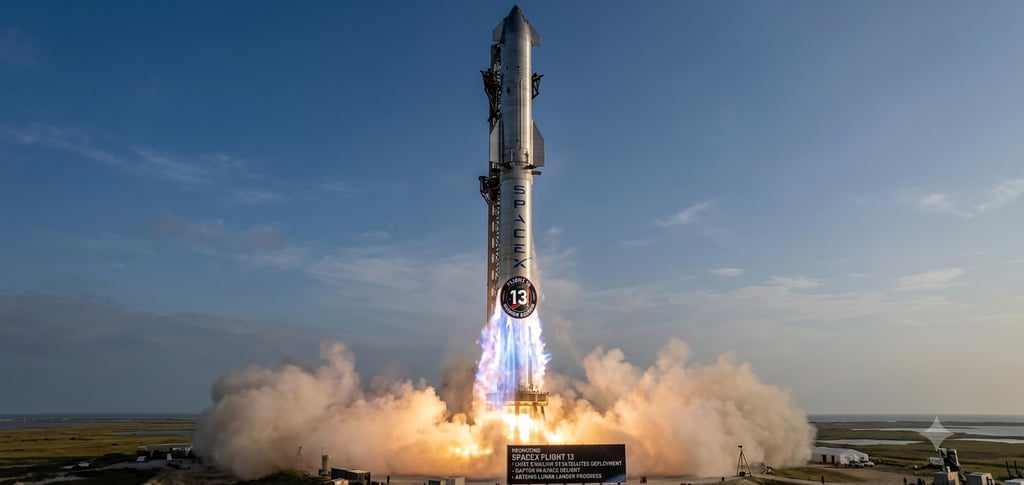
Reaching for the Stars: The Legacy of SpaceX's Historic Flight 13
When historians look back at the dawn of the multi-planetary era, specific milestones will stand out as turning points in human ambition. Among them, SpaceX's Flight 13 stands as a masterclass in modern aerospace engineering—a mission where history, cutting-edge technology, and relentless human effort collided to push the boundaries of what is possible.
For space enthusiasts, engineers, and dreamers alike, Flight 13 wasn't just another launch. It was a statement of resolve.
1. The Launch: Precision in the Face of Power
From the moment the countdown reached zero, the sheer power of the mission was undeniable. Clearing the pad on a column of fire, the vehicle surged through Max-Q—the point of maximum aerodynamic pressure—with flawless precision.
Achieving a clean orbital insertion requires thousands of sub-systems to operate in perfect harmony under extreme stress. Flight 13 demonstrated an incredible refinement in guidance systems and engine throttle control, ascending through the atmosphere like a finely tuned machine.
2. The Landing: Mastering the Art of Reuse
While getting to space is hard, returning from it in one piece was long considered impossible for operational rockets.
As the first-stage booster detached and performed its boostback burn, telemetry data tracked a precise return trajectory back toward the landing site. The entry burn shed thousands of miles per hour of velocity, slicing through the thin upper atmosphere before igniting its engines one final time for the landing burn.
Touchdown was soft, centered, and decisive.
By perfecting hypersonic entry and precision grid-fin control, SpaceX didn't just land a booster—they continued to solidify the viability of full, rapid reusability. This single capability remains the linchpin in reducing the cost of access to space by orders of magnitude.
3. History and Remarkable Achievements
To understand the weight of Flight 13, one must look at the arc of spaceflight history. For decades, space exploration was defined by expendable hardware—multi-million-dollar vehicles built to fly once and sink into the ocean.
Flight 13 represents a profound shift in this paradigm:
Unprecedented Reusability: Proving that hardware can withstand the thermal and structural punishment of re-entry repeatedly.
Rapid Turnaround: Shortening the window between recovery and static fire testing, proving that rockets can be operated more like commercial airliners than custom craft.
Payload Efficiency: Delivering heavier, more complex payloads while retaining enough reserve fuel for recovery maneuvers.
4. Engineering & New Technology Demonstrations
Behind the spectacle of the launch lies a massive leap in aerospace design. Flight 13 served as a live testbed for several breakthrough technologies:
Advanced Thermal Protection: Next-generation heat shielding capable of enduring re-entry temperatures exceeding 2,000°C without requiring heavy refurbishment between flights.
Avionics & Autonomous Guidance: Real-time trajectory adjustments powered by advanced onboard compute systems, allowing the booster to make millisecond-level corrections during descent.
Propulsion Optimization: Refined fuel-to-oxidizer ratios and upgraded engine components that deliver higher thrust-to-weight performance while minimizing mechanical wear.
5. The Unsung Hero: Teamwork & Grit
It is easy to focus on the hardware, but the real engine behind SpaceX is its people.
A launch day is the culmination of tens of thousands of hours worked by software engineers, welders, launch directors, technicians, and logistics teams. When an anomaly occurs, it is this team that works through the night to analyze telemetry, run simulations, and deploy fixes.
Flight 13 was a monument to human collaboration—a thousands-strong team working across multiple facilities in total sync to turn complex physics into an operational reality.
6. The Philosophy: Innovation Through Failure
At the heart of SpaceX's rapid progress is a distinct design philosophy championed by founder Elon Musk:
"Failure is an option here. If things are not failing, you are not innovating enough."
Where traditional aerospace programs spent decades analyzing designs on paper to avoid any risk of public failure, SpaceX embraced rapid iteration—build, test, fail, fix, and fly again. Flight 13 was not built in a vacuum; it was built on the lessons learned from every prototype that came before it.
This mindset reframes setback not as a defeat, but as data.
Looking Ahead: The Horizon for Quantum Jet Space
As we analyze missions like Flight 13 here at Quantum Jet Space, one truth becomes clear: we are living in the most dynamic era of space exploration since the Apollo program. The commercial space ecosystem is accelerating, deep-space infrastructure is being laid, and the path to permanent human presence beyond Earth is being forged step by step.
Flight 13 proved that with radical hardware design, an unwavering work ethic, and the courage to fail forward, the stars are no longer out of reach.